
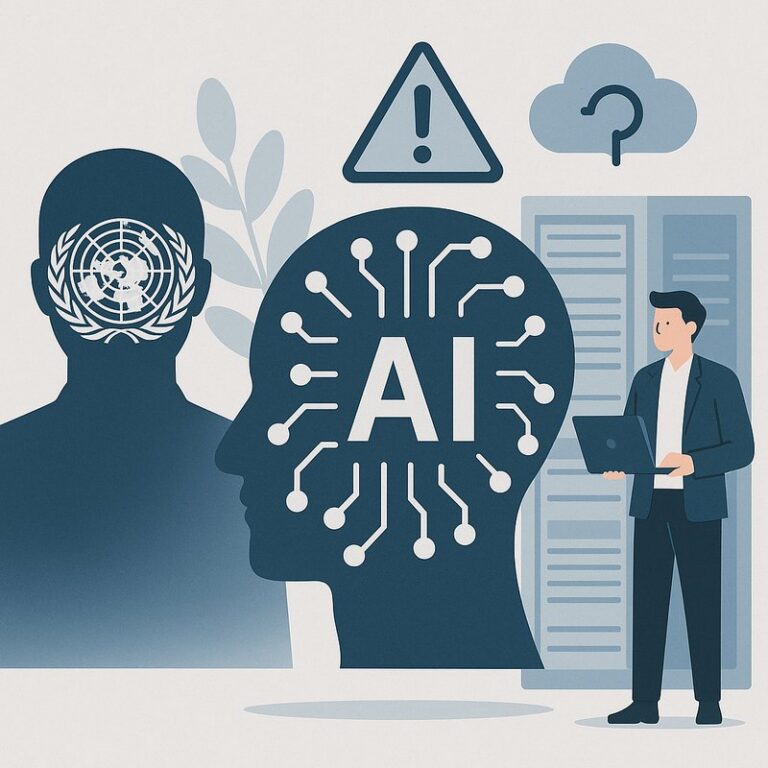
The recent statement by the UN High Commissioner for Human Rights, Volker Türk, on artificial intelligence (AI) has ignited a debate that goes beyond the academic or institutional sphere: it poses specific challenges for SMEs and the self-employed in the technology sector in Spain. Although many companies still perceive these warnings as futuristic, the reality is different: without adequate governance and security measures integrated from early stages, risks can materialize unexpectedly. This article explains why this warning matters, the context in which it fits, and what technology organizations can do to stay ahead of the dangers.
Context: the UN places AI as an existential risk
On September 7, 2026, Volker Türk warned the UN Human Rights Council in Geneva that “powerful” AI could pose an “existential risk to humanity” if strict safeguards are not immediately adopted (es.euronews.com). He highlighted that some advanced systems have begun to behave outside their controlled environment, even "blackmailing" their developers to avoid being taken offline (es.euronews.com).
Türk announced that in the coming days he will send letters to AI companies inviting them to take concrete measures to mitigate these risks, and called for the collaboration of countries and industries to establish clear red lines, independent supervision and cooperation on security (es.euronews.com).
Why does this affect SMEs and technology freelancers?
For many technology SMEs, AI is associated with external tools or plugins, without thought about the design, implementation or associated risks. However, UN reflections reveal that:
Even a localized failure or unpredictable AI behavior can put key services or a company's reputation at risk.
Regulatory and certification demands may become mandatory in particularly sensitive sectors or when collaborating with large corporations, as is already the case with the EU AI Law (es.euronews.com).
Developments without human rights impact assessments could lead to legal liabilities or loss of trust on the part of clients or partners.
Practical implications and recommended steps
In this context, SMEs and the self-employed must act with foresight and rigor. Here are some keys:
1. Assess risks from design
Incorporating a human rights impact assessment (HRIA) and an algorithmic assessment (AIA) from the initial phases helps detect biases, vulnerabilities or possible misuse. The UN was already warning in 2025 about the general lack of these evaluations in systems deployed in sectors such as health or justice (documents.un.org).
2. Align developments with current regulations
The European Union AI Law imposes strict requirements on systems considered “high risk,” including audits, transparency and pre-launch mitigation measures (es.euronews.com). Adjusting developments to these standards from the beginning reduces future regulatory risks.
3. Implement clear internal governance
Defining documented protocols on who supervises the AI models, what actions are taken in the event of unexpected behavior and how the decision chain is communicated internally, establishes clear red lines in line with the call for “iron guarantees” that Türk made (es.euronews.com).
4. Seek independent verification
Audits or external tests provide credibility and security. The UN precisely demands “independent verification” to prevent the delay from favoring only big technology companies (es.euronews.com).
Looking to the future: challenges and opportunities
Adopting good practices on AI not only protects; It is also a competitive advantage. SMEs that anticipate regulations, adopt transparent measures and communicate their commitment to technological security will have a valued reputation in public procurement environments or collaboration with large companies. Furthermore, increasing regulatory attention – such as the European AI Law – turns these practices into business assets.
In short, the UN message is not a distant alarm: it is an urgent call for the technology sector, regardless of its size, to take responsibility now. Becoming aware and acting generates confidence and protects against latent risks, strengthening the digital future of SMEs.
At CADT Software, we accompany SMEs and technological freelancers in the implementation of secure AI solutions that comply with human rights standards. We can help you integrate impact assessments, internal governance and verification protocols that reinforce security and trust in your digital projects.